When a production line runs for hours at a time, even minor shifts in dough development can affect divider accuracy, proofing performance, finished weight, and overall yield. A few grams per piece may seem insignificant, but across thousands of units, those differences quickly impact profitability.
That is why manufacturers rely on Exact Mixing and continuous mixing technology to improve stability in large-scale dough production.
Why Batch Mixing Can Create Inconsistency
Traditional batch mixing operates in defined cycles. Ingredients are loaded, mixed, discharged, and the sequence repeats. In high-output bakeries, large-capacity mixers or staggered batch systems are often used to maintain supply, but each batch remains a separate mixing event.
Even with standardized procedures, small differences in timing, ingredient temperature, scaling accuracy, or operator adjustments can influence how each batch develops. Over long production runs, those minor differences accumulate and begin to show downstream.
The effects are subtle but important. Divider settings require adjustment, proofing behavior becomes less predictable, and finished weights start to drift. Managing those fluctuations takes time and increases the risk of waste or giveaway.
From Cycles to Steady Production
Continuous mixing removes the start-and-stop rhythm of batch production. Dry and liquid ingredients are metered directly into the mixer at controlled, consistent rates, while dough exits at the same pace it is consumed downstream.
Once the system reaches equilibrium, operating conditions remain stable. There are no batch resets and no transition periods between cycles. Dough is developed under the same parameters throughout the run, supporting higher throughput and more uniform output.
This steady-state operation is the foundation for improved consistency in high-volume environments.
Why Lower Weight Variation Matters
Piece weight is one of the clearest indicators of upstream stability. When dough characteristics fluctuate, divider performance follows. Even small swings can lead to product giveaway or require frequent operator intervention.
Comparative testing between batch systems and Exact Mixing’s continuous mixing systems highlights this difference clearly. In a production comparison using similar products and forming equipment, batch mixing produced a standard deviation of approximately 1.11 grams, while continuous mixing reduced that variation to 0.45 grams. That represents less than half the weight variation over time.
With tighter weight distribution, bakeries can set divider targets closer to specification, reduce overfill, and maintain consistency through proofing and baking. The result is improved finished-product uniformity and fewer adjustments during long runs.
Integrated Ingredient Management
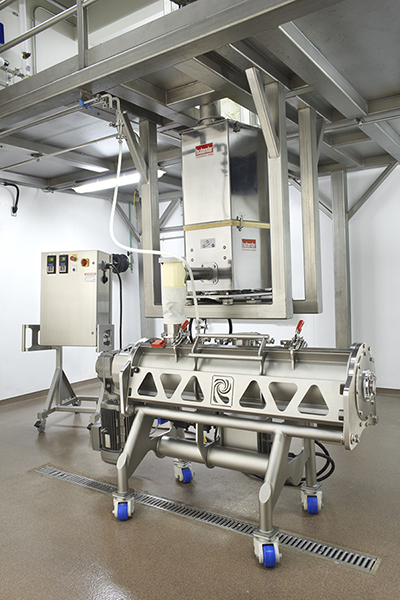
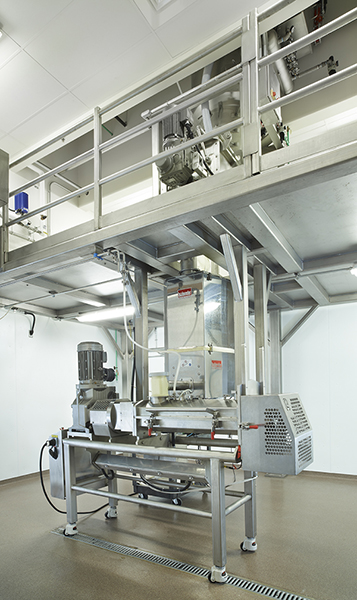
Exact Mixing’s continuous mixers function as coordinated production systems rather than standalone machines. A complete system typically includes:
- Dry material receiving
- Ingredient handling and optional pre-blending
- Gravimetric loss-in-weight dry feeding
- Automated liquid metering with flow control
- Continuous dough development
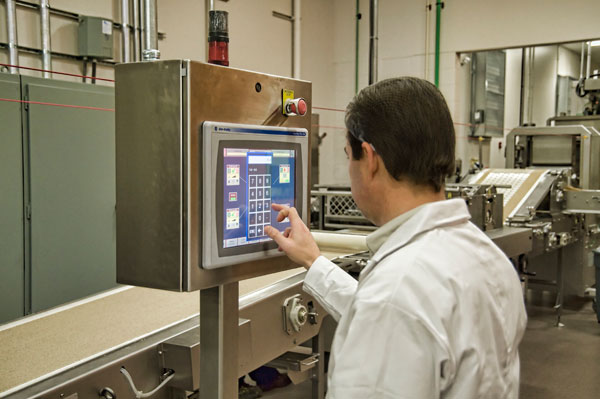
- Centralized operator interface
Dry ingredients may be fed from silos, bulk bags, or smaller containers, with pre-blending used to improve distribution before mixing. Loss-in-weight feeders maintain uninterrupted dry flow, while liquids are delivered through feedback-controlled flow systems for accurate dosing.
Because ingredient delivery is regulated continuously rather than weighed and discharged intermittently, hydration and formulation remain consistent across the entire production window.
Centralized Oversight and Control
Continuous systems provide operators with a centralized interface that monitors ingredient flow, mixing parameters, and overall system performance. Production settings can be verified and adjusted as needed, and operational data can be logged for review.
Instead of evaluating quality batch by batch, teams oversee a monitored process that remains stable throughout extended production schedules and multiple shifts. This visibility supports sustained consistency and faster response when adjustments are required.
Engineered for Large-Scale Reliability
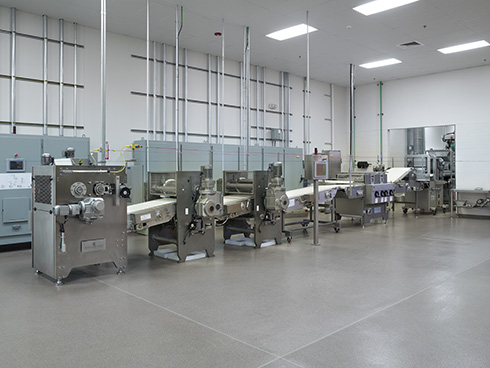
High-capacity bakeries depend on stable performance across the entire line. Continuous mixing systems are designed to integrate seamlessly with dividers, proofers, and ovens so that dough moves forward under steady conditions.
For bakeries focused on efficiency and uniformity, consistency becomes a measurable advantage. By combining precise ingredient metering, steady mixing conditions, and integrated control, continuous mixing reduces variability at its source.
Commercial testing confirms tighter weight distribution and improved output stability over extended runs. In environments where every gram and every minute influence cost, that level of control delivers real operational value.
Improve Stability Across Every Shift
When high-volume production demands uniform dough performance, continuous mixing delivers steady ingredient control and reduced variation. Contact Exact Mixing to explore solutions tailored to your line configuration and output goals.